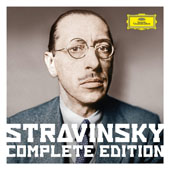
Here
you get all the famous ballets, from Firebird, Petrushka and The Rite
of Spring (all Boulez recordings), through Pulcinella (Abbado) Apollon
musagète (Chailly) to Agon, the operas from The Nightingale (Boulez) to
The Rake’s Progress (Gardiner) and idiosyncratically Stravinskian works
like Renard (Chailly), Les Noces (Bernstein) and Mavra (Rozhdestvensky) –
as well as Oedipus Rex (Philip Langridge under James Levine), and
rarities like Persephone and Orpheus
CD 13 – 18 Orchestral Music
Starting
with the almost traditional Symphony no. 1 in E flat (Pletnev), these
six CDs bear witness to Stravinsky’s incredible stylistic transformation
with a rich array of neo-classical works (3 CDs) including the Symphony
in C and the Symphony in 3 Movements, delightful miniatures like the
two Suites for small orchestra, the concertante works for piano and
violin, the jazzy Ebony Concerto and Tango, the hilarious Greeting
Prelude written for Pierre Monteux’s 80th birthday – you’ve never heard
“Happy Birthday to You” like this before – and the ascetic later works.
Rounded off by revised versions (Suites) from Firebird and Petrushka.
CD 19 – 21 Choral Music
Three
CDs of choral music comprising famous works like the Symphony of Psalms
(Gardiner) and Mass (Bernstein), but also many rarities: short Russian
sacred works, Babel, Threni (Robert Craft), A Sermon, a Narrative and a
Prayer (Robert Craft) that repay closer listening.
CD 22 – 23 Solo Vocal
A
fascinating sequence of songs (with Lucy Shelton and John Constable)
from Stravinsky’s earliest period, many presented in the original voice
and piano versions as well as later arrangements for voice and chamber
ensemble (soloists like Ann Murray and John Shirley-Quirk under Pierre
Boulez), ending with The Owl and the Pussy-Cat from 1966.
This
section also includes what may be a world-premiere recording of the
short Hommage à Nadia Boulanger, written for her 70th birthday in 1947,
sung by two American singers from the Deutsche Oper Berlin, Heide Stober
and Ronnita Millar.
CD 24 – 25 Chamber Music
Beside
original chamber works – the great Octet and Septet, for example –
there are many popular works arranged from ballets that are regularly
played in concert: the Suite italienne (in the cello and piano version,
with Maisky and Argerich), The Soldier’s Tale Concert Suite and the
Divertimento from The Fairy’s Kiss. Not to forget quirky items like the
Duet for two bassoons, the 24-second Pour Pablo Picasso for solo
clarinet (written down on a postcard) and the late Fanfare for a New
Theatre for two trumpets.
CD 26 – 27 Piano Music
The
piano was essential to Stravinsky’s composition method, and he himself
composed works to play in concerts. Here, alongside Maurizio Pollini’s
unrivalled account of the Three Movements from “Petrushka”, we have
excellent performances of neo-classical works like the Sonata and the
Serenade in A by the French pianist Marie-Francoise Bucquet; the Labèque
sisters and the Kontarsky brothers cover the piano duets and two-piano
works admirably.
AND there are three more new recordings,
wonderfully rendered by the young Icelandic pianist Vikingur Olaffson –
not quite world premières but very rare: Scherzo in G minor of 1902, the
Valse des fleurs (piano duet) and the Souvenir d’une marche boche
(1915), whose irony is wonderfully captured by the artist.
CD 28 – 29 Historical Recordings
In
the vaults of DG and Decca/Philips there lie some wonderful gems from
the past, of considerable historical value and significance: the Violin
Concerto with Dushkin and Stravinsky mentioned above, and The Soldier’s
Tale with Jean Cocteau as Narrator conducted by Igor Markevitch; plus
two classic accounts of early ballets from Ansermet and Monteux,
conductors intimately associated with Stravinsky during his lifetime.
CD 30 Bonus
Finally,
we couldn’t resist including last year’s sensation: Martha Argerich and
Daniel Barenboim making sparks fly in the pian duet arrangement of The
Rite of Spring.